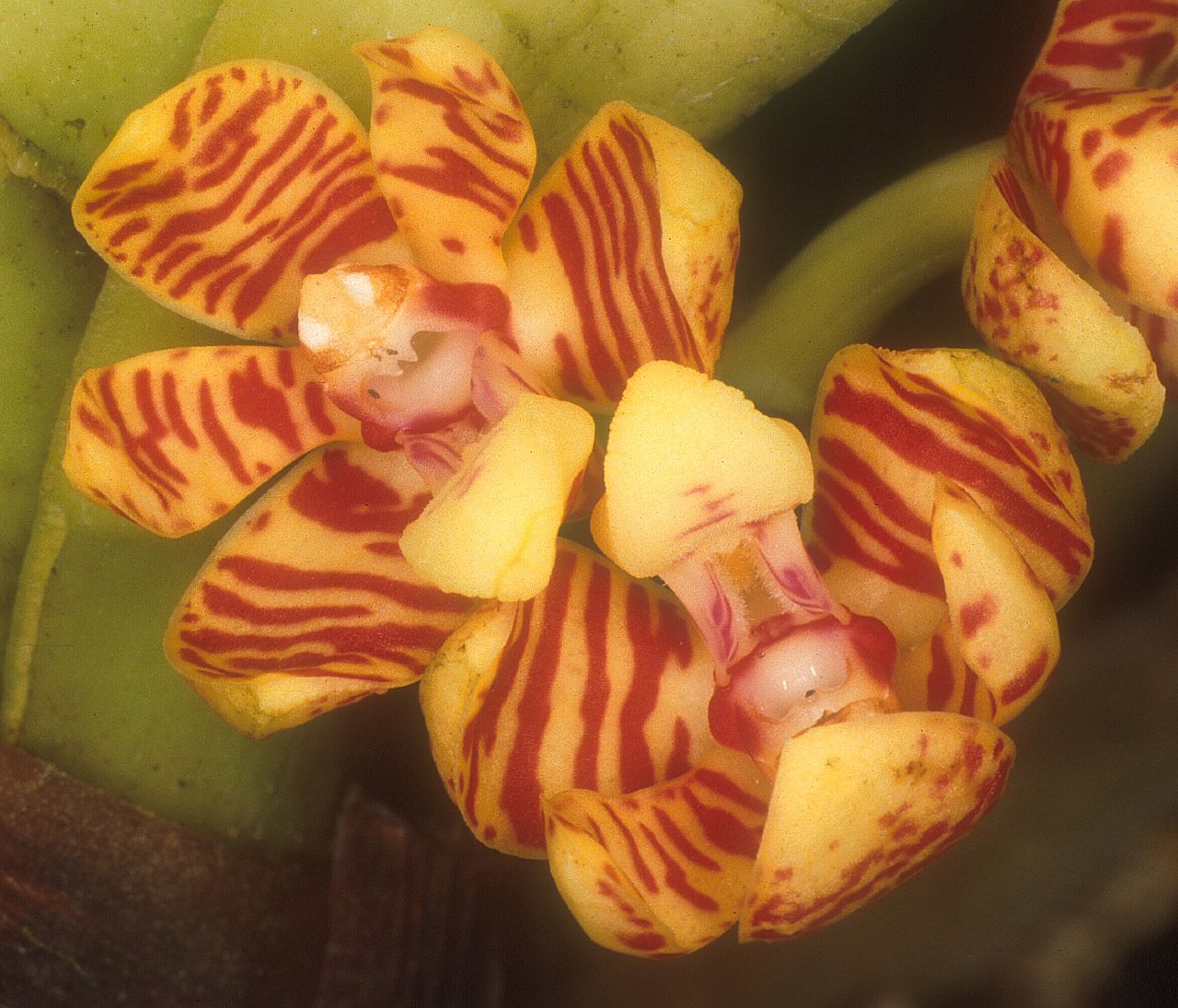
A genus of 25 high Andean, grassland terrestrials that grow cold and are not normally found in cultivation. They are characterized by a basal rosette of leaves with a lateral elongate inflorescence that has small flowers surrounded by papery bracts that are shorter or longer than the flowers which are all clustered, cylyndrically at the apical end and it has an inverted lip that is hood-shaped that has fimbriate margins.
Common Name or Meaning Named for Peter Van der Aa - Editor and publisher in the 1600 to 1700's]
- Aa achalensis Schltr. 1920
- Aa argyrolepis Rchb.f. 1854
- Aa colombiana Schltr. 1920
- Aa hartwegii Garay 1978
- Aa maderoi Schltr. 1920
- Aa nervosa (Kraenzl.) Schltr. 1912
~Aa nubigena (Rchb.f.) Schltr. 1912 - See Myrosmodes nubigenum Rchb.f. 1854
- Aa paleacea [Kunth] Rchb.f 1854
~Aa pumilio Schltr. 1921 - See Myrosmodes nubigenum Rchb.f. 1854
- Aa sp Peru


~`Abaxianthus M.A.Clem. & D.L.Jones 2002- See Dendrobium Sw. 1799 SUBFAMILY Epidendroideae, TRIBE Dendrobeae, SUBTRIBE Dendrobiinae
All the members of this genus have been moved to Dendrobium or Dockerilla.
~Abaxianthus convexus (Blume) M.A.Clem. & D.L.Jones 2002 - See Flickingeria convexa (Blume) A.D. Hawkes 1965
Abdominea J.J. Sm.1914 SUBFAMILY Epidendroideae, TRIBE Vandeae, SUBTRIBE Aeridinae.
This is a monotypic, lithophytic or epiphytic genus that consists of small plants with very short stems and a few elliptic leaves that blooms on an unbranched, elongate, many flowered inflorescence with many, well-spaced, small flowers with petals broader than sepals, the 3 lobed lip with small triangular side lobes and the acute, erect mid-lobe with a transverse basal callus all fused at the base to the column and spurred. The Anther has a beak and the rostellum is larger, longer and wider than the column and basally co-joined by a narrow base. There are 4 very unequal, pollina united in two pairs on narrow apically wider stipes and having a large disc.
Common Name or Meaning In Latin means belly, used here to show that the lip has a similarity to the abdomen of an insect
Type species = ! = Abdominea micrantha J.J. Sm. 1914
- Abdominea minimiflora (Hook. f.) J.J. Sm. 1917
To
~Abdominea micrantha J.J.Sm. 1914 - See Abdominea minimiflora (Hook. f.) J.J. Sm. 1917
~`Aberrantia Luer 2005 - See Pleurothallis R. Brown 1813 SUBFAMILY Epidendrodeae, TRIBE Epidendreae, SUBTRIBE Pleurothallidinae
Aberrantia aberrans (Luer) Luer 2005 - See Pleurothallis aberrans Luer 1978
~`Abola Lindley 1853 - See Caucaea Schltr.1920 SUBFAMILY Epidendroideae, TRIBE Epidendreae, SUBTRIBE Oncidiinae
~*Abola radiata Lindley 1853 - See Caucaea radiata (Lindl.) Mansf. 1934
`Acacallis Lindley 1853 SUBFAMILY Epidendroideae, TRIBE Maxillarieae, SUBTRIBE Zygopetalinae.
Acacalis is a new world, pendulous genus with 3 to 4 species, found in Brazil, Venezuela, Peru and Colombia, and was first described by Lindley in 1853. High humidity and hot to warm temperatures are a must to maintain this species. This genus is chara cterized by the pendulous plant habit, a long, slender column foot, and a short, broad stipe of the pollinarium, and 4 hard pollina
Common Name or Meaning Latinized ancient greek for Akakallis a nymph that was a freind of the god Apollo
Synonyms `Kochiophyton Schlechter 1906; Warreella Schltr. 1914
Type species = ! = Acacalis cyanea Lindley 1853
- !Acacallis cyanea Lindley 1853
To
To
~Acacallis fimbriata (Rchb. f.) Schltr 1918 - See Aganisia fimbriata Rchb.f. 1874
~Acacallis hoehnei (Hoehne) Schltr 1918 - See Acacallis cyanea Lindley 1853
~Acacallis oliveriana (Rchb. f.) Schltr 1914 - SeeAganisia fimbriata Rchb.f. 1874
- Acacallis rosariana V.P.Castro & da Silva 2001
~Acacallis caerulea (Rchb.f.) Schltr. 1918 - See Aganisia fimbriata Rchb.f. 1874
~Acacallis coerulea (Rchb. f.) Schltr. 1918 - See Aganisia fimbriata Rchb.f. 1874


Acampe Lindley 1853 SUBFAMILY Epidendroideae, TRIBE Vandeae, SUBTRIBE Aeridinae.
A monopodial, vandanaceous, epiphytic genus with about 10 species from Africa, the Himalayas, Malaysia and Southern China that can grow into large clumps of robust epiphytes or lithophytes with small spotted or barred flowers. The sepal and petals are similar, the lip is saccate or spurred, there are 4 pollina in two unequal parts with one long stipe and one very small viscidium.
Common Name or Meaning Ancient greek for rigid, refering to the leaves
Type species = ! = Acampe multiflora [Lindley]Lindley 1853 = Acampe rigida [Buch.- Ham. ex J.E.Smith]P.F. Hunt 1970
- Acampe ochracea (Lindl.) Hochr. 1910
- Acampe pachyglossa Rchb. f. 1881
To
~Acampe pachyglossa subsp. reschiana (Rchb.f.) Senghas 1964 - See Acampe pachyglossa Rchb. f. 1881
~Acampe pachyphylla (Ames) Szlach. 2003 - See Sarcophyton pachyphyllum (Ames) Garay 1972
- Acampe papillosa (Lindley) Lindl. 1853
~Acampe penangiana Ridl. 1896 - See Acampe rigida (Buch.-Ham. ex Sm.) P.F.Hunt 1970
~Acampe praemorsa (Roxb.) Blatt. & McCann 1932 - See Acampe papillosa (Lindley) Lindl. 1853
~Acampe renschiana Rchb.f. 1881 - See Acampe pachyglossa Rchb. f. 1881
- Acampe rigida (Buch.-Ham. ex Sm.) P.F.Hunt 1970
~Acampe taiwaniana S.S.Ying 1974 - See Acampe rigida (Buch.-Ham. ex Sm.) P.F.Hunt 1970
~Acampe thailandica Seidenf. 1997 - See Staurochilus joiceyanus (J.J. Sm.) Seidenf. 1988
~Acampe wightiana (Lindl. ex Wight) Lindl. 1853 - See Acampe papillosa (Lindley) Lindl. 1853
~Acampe wightiana var. longipedunculata Trimen 1885 - See Acampe rigida (Buch.-Ham. ex Sm.) P.F.Hunt 1970
~Acampe carinata (Griff.) S.G. Panigrahi 1985 -See Acampe papillosa (Lindley) Lindl. 1853
~Acampe crassifolia (Lindl. & Paxton) Szlach. 2003 - See Cleisostoma crassifolium Lindl. & Paxton 1852-3
~Acampe dentata Lindl. 1853 - See Acampe ochracea (Lindl.) Hochr. 1910
~Acampe griffithii Rchb.f. 1872 - See Acampe ochracea (Lindl.) Hochr. 1910
~Acampe intermedia Rchb.f. 1856 - See Acampe rigida (Buch.-Ham. ex Sm.) P.F.Hunt 1970
~Acampe joiceyana (J.J.Sm.) Seidenf. 2002 publ. 2003 - See Staurochilus joiceyanus (J.J. Sm.) Seidenf. 1988
~Acampe loheriana Kraenzl. 1921 - See Staurochilus loheriana [Kraenzl.] Christenson 1992
~Acampe longifolia (Lindl.) Lindl. 1853 - See Acampe rigida (Buch.-Ham. ex Sm.) P.F.Hunt 1970
~Acampe madagascariensis Kraenzl. 1891 - See Acampe pachyglossa Rchb. f. 1881
~Acampe mombasensis Rendle 1895 - See Acampe pachyglossa Rchb. f. 1881
~Acampe multiflora (Lindl.) Lindl. 1853 - See Acampe rigida (Buch.-Ham. ex Sm.) P.F.Hunt 1970
~Acampe nyassana Schlechter 1915 - See Acampe pachyglossa Rchb. f. 1881
Acanthephippium Blume ex Endl. 1828 SUBFAMILY Epidendroideae, TRIBE Arethuseae SUBTRIBE Bletinae
There are 11 terrestrial or rarely lithophytic species in tropical Asia, Malaysia and out to the islands of Fiji. They are compared to Phaius in their culture and have epiphytic like roots, long, furrowed, succulent-like pseudobulbs with plicate leaves and a few cup or bottle-shaped, fragrant flowers on a short stumpy inflorescence arising with the new growth. The flowers have sepals that cohere into an obliquely jug-shaped body that are free at the top, l;ateral sepals that are much broader than the dorsal, deccurrent on the column foot and forms a mentum with it. The very mobile, small, saddle-shapped lip is on top of the column foot and has a disc with varrying amounts of longitudinal keels. There are 8, waxy pollina in two separate bundles all attached to a short, granular stalk.
Synonyms Acanthophippium Blume 1825;
Common Name or Meaning refers to the saddle-like lip with thorn-like points
Type species = ! = Acanthephippium javanicum Blume 1828